From assessment to development
Every assessment shows what an athlete needs to develop.
The PROVEN drill library connects each performance limiter to the exercises that fix it. Those same drills run our Youth Development and Small Group Training programs. Here are six examples of how an assessment result becomes purposeful training.

Wall Drill (Knee Drive)
Teaches the lean, the push and the knee drive of the first steps, without the speed getting in the way.

Max-Velocity Wickets
Mini hurdles set the stride. The athlete runs tall, steps down under the hips and holds the rhythm at speed.

Pogo Hops
Quick, stiff ankle hops teach the legs to spend less time on the ground and give more force back.
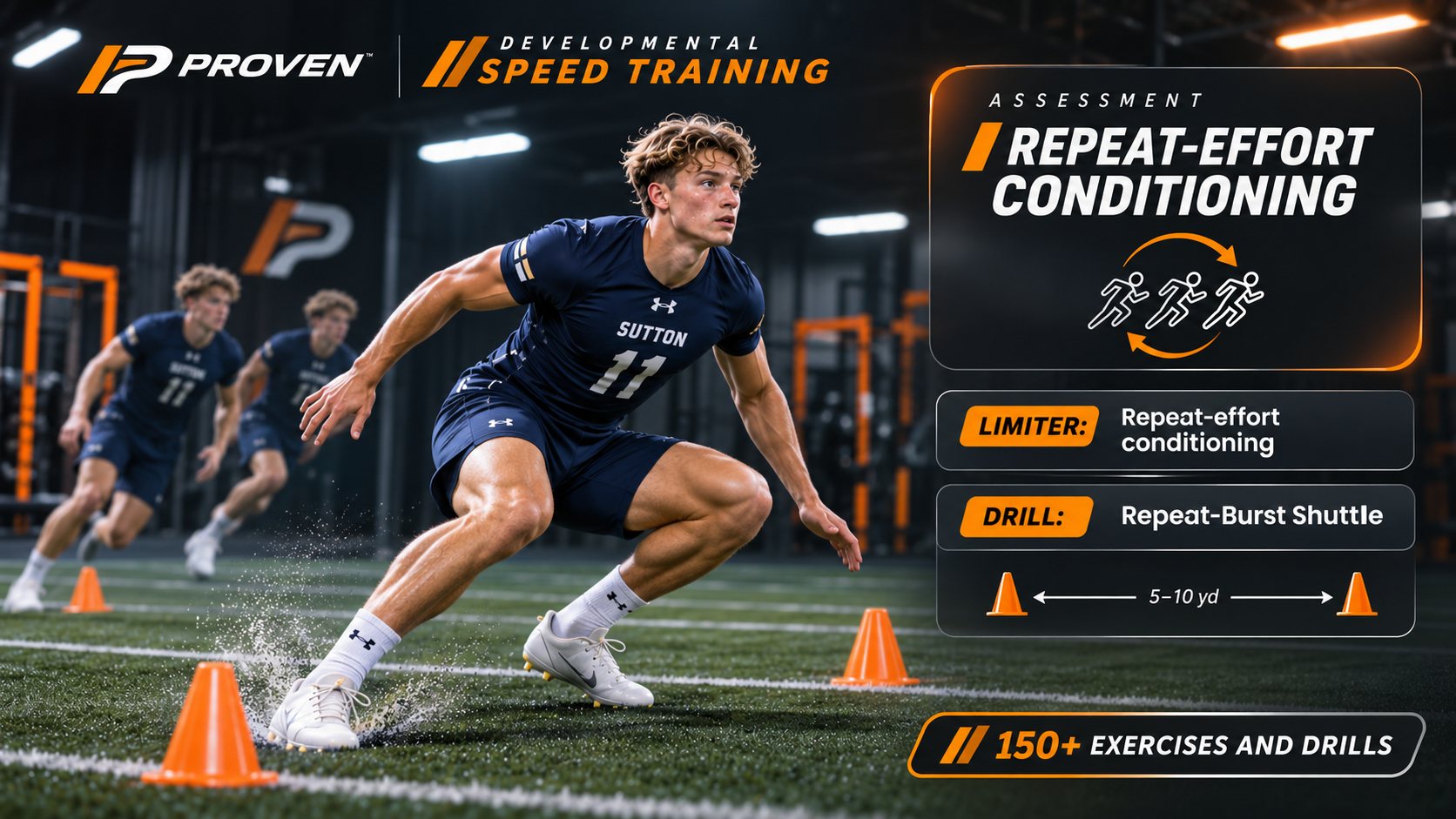
Repeat-Burst Shuttle
Short bursts between cones with timed rest. Heart rate shows when the athlete is ready to go again.

45-Degree Plant & Cut
A low, outside plant and a sharp cut. The weaker side goes first and gets the extra reps.

2-Step Deceleration
Stop in two steps with the hips low and the chest over the knees, then drive out again.
We don’t just run drills. Every drill has a purpose.
154 exercises and drills in the PROVEN library, in nine categories.
Program: turn the limiters into a plan
Every plan is built from the athlete’s own assessment, in four steps. Nobody gets a copy of somebody else’s program.
- 1Find the limitersResults below the range for the athlete’s age and sport, explained by the video.
- 2Rank themThe limiter that costs the most time is Priority 1. Results in range are maintained.
- 3Pick the drillsEach priority gets drills from the library that target that limiter, and only that limiter.
- 4Set the targetsEvery priority gets a number to hit at the week-4 retest, like 20 yards in 3.25 s.
| 4-week block | Sat · Field | Sun · Track | Weekday 1 · App | Weekday 2 · App |
|---|---|---|---|---|
| Week 1Learn the positions | Wall drills and falling starts. Gates time every start to set a baseline. | Pogo hops, wickets at a slow rhythm, 2-step decel walk-throughs. | Strength: trap-bar deadlift, split squats, hip thrusts. Light loads, clean reps. | Low jumps and single-leg hops, weaker side first. Warm-up and mobility. |
| Week 2Add load | Resisted and partner starts. 45° plant & cut, weaker side first. | Hurdle hops, max-velocity wickets, brake & go at 75%. | Heavier strength sets. Nordics for the hamstrings. | Broad jumps and drop jumps. HR repeat-burst shuttle once. |
| Week 3Full speed | Full-speed starts on the gates. Cuts and brakes at game speed. | Drop jumps, flying 10s, repeat-burst shuttle with heart rate. | Heaviest strength week, fewer reps. | Jump-to-sprint combos. Maintain top speed with A-skips. |
| Week 4Lighter, then retest | Short, sharp session. Volume drops so the athlete is fresh. | Retest: same tests, same start line, same camera spot. | Strength check: one top set. | Recovery: light jumps and 15 minutes of mobility. |
Field days are small-group sessions with Coach Jafar. Weekday sessions take 35–45 minutes on your own, on any two days, with the PROVEN app.
Train: technology in every session
Saturdays and Sundays you train on the field and track with Coach Jafar. On two weekdays you train on your own with the PROVEN app. Every session collects data, and that data decides the next session.
Timing gates
Laser gates time every 40 and the split at the 20, to the hundredth.
HR strap
Shows live heart rate and how fast it drops between rounds.
Phone camera
PROVEN tracks the body on video and measures the one angle that matters.
Shin sensor
A small motion sensor on each shin measures every foot strike.
PROVEN app
Weekday sessions with Coach Jafar’s AI voice talking through every set.
- ✓Cue holds: progressWhen the cue holds on 5 of 6 reps two sessions in a row, the drill gets harder.
- ↓Tired: pull backWhen effort hits 9 out of 10 or heart rate recovers slowly, a round comes out.
- →Results go to the coachWeekday app sessions land in Coach Jafar’s dashboard before the next field day.
Youth Development · ages 9 and up
Younger athletes follow the same plan, built for them.
In Youth Development the training plan works on each assessment as a skill: running mechanics first, then sprint mechanics, time and space awareness, and speed endurance to build mindset. No benchmarks to chase.
See the youth plan →Prove: retest the same way and compare
In week 4 every athlete runs the same tests from the same start line, filmed from the same spot. We check two things: were the targets hit, and did the qualities we trained improve more than the ones we didn’t? If only the trained qualities moved, the program made the difference, not a good day or a growth spurt.
| Test | Before | After | Target |
|---|---|---|---|
| 0–20 split | 3.41 s | 3.24 s | Met ≤ 3.25 s |
| Broad jump | 7′7″ | 8′1″ | In band |
| Brake & go stop | 2.6 m | 2.1 m | Met ≤ 2.2 m |
| 40 yards | 5.57 s | 5.38 s | Faster −0.19 s |
| 20–40 split (not trained) | 2.16 s | 2.14 s | Control |
The proof
The start, the quality we trained, improved 5.0%. The second 20, which was only maintained, moved 0.9%. That gap is the evidence the plan worked.
Next block: reactive strength and the left-foot plant become the main priorities.